Aloe vera is a perennial succulent valued for its medicinal gel and drought tolerance. It belongs to the family Asphodelaceae, subfamily Asphodeloideae.
Taxonomic Classification
| Rank | Classification |
|---|---|
| Kingdom | Plantae |
| Clade | Angiosperms |
| Clade | Monocots |
| Order | Asparagales |
| Family | Asphodelaceae |
| Subfamily | Asphodeloideae |
| Genus | Aloe |
| Species | Aloe vera (= Aloe barbadensis Mill.) |
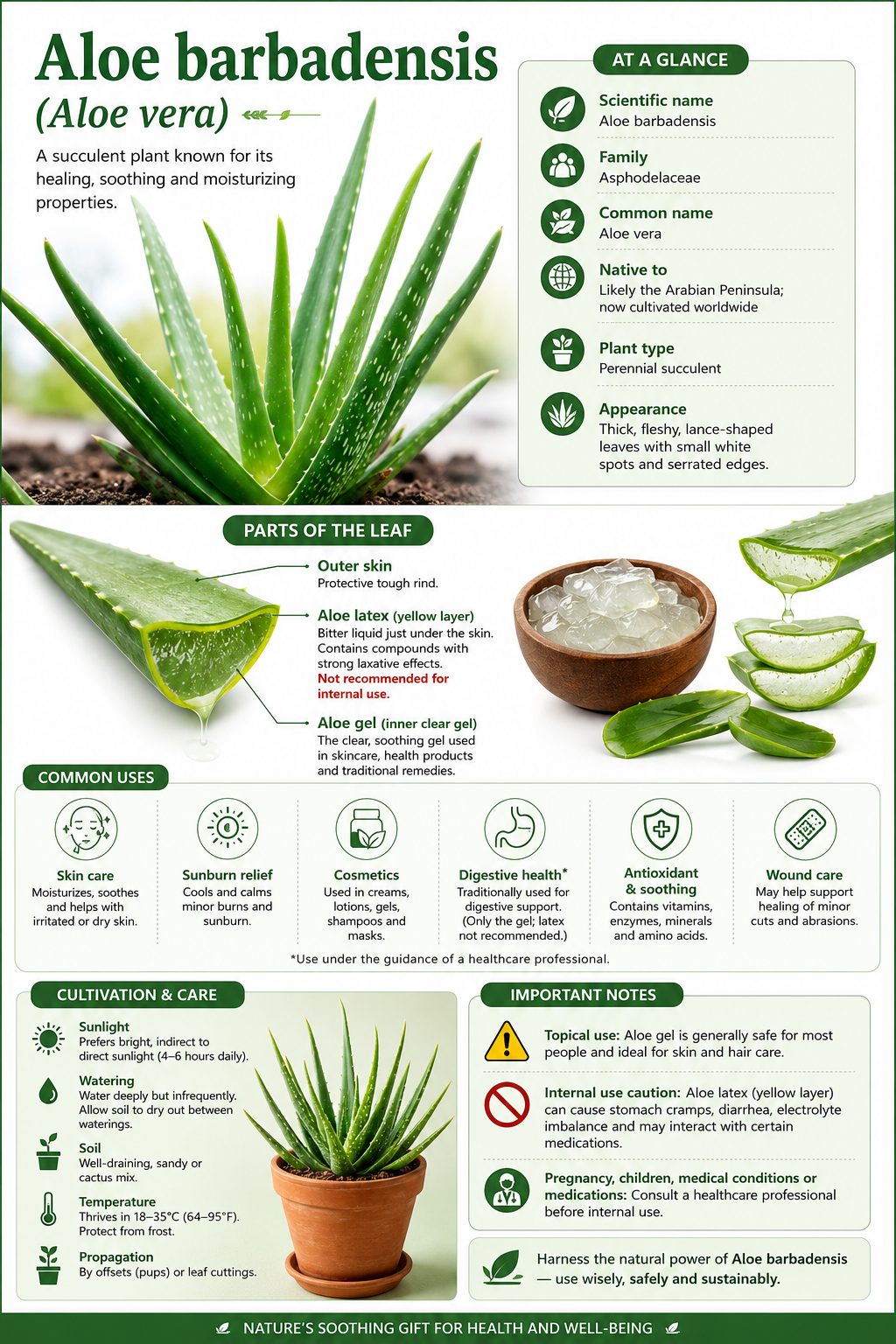
Growth Habit
- Evergreen succulent perennial
- Forms a basal rosette of fleshy leaves
- Typically grows 60–100 cm tall and wide
- Produces numerous offsets (pups) around the base
Leaves
- Thick, succulent, lance-shaped
- Gray-green to bluish-green
- Margins armed with small whitish teeth
- Length: 30–60 cm
- Width: 5–8 cm
- Interior contains clear mucilaginous gel
- Yellow latex occurs beneath the leaf rind
Root System
- Fibrous and relatively shallow
- Adapted for rapid absorption of water after rainfall
- Sensitive to prolonged waterlogging
Flowers
- Produced on tall, unbranched or sparsely branched stalks (inflorescences)
- Flowers are tubular and pendulous
- Usually yellow, yellow-orange, or occasionally reddish
- Rich in nectar and attractive to pollinators
Flower Structure
- Perianth: tubular, six tepals
- Stamens: six
- Ovary: superior, three-celled
Flowering Time
In tropical climates such as the Philippines:
- Usually flowers when mature (3–5 years old)
- Most commonly blooms during the dry season or cooler months
- Flowering may be irregular in heavily shaded locations
Fruit and Seeds
- Fruit type: Capsule
- Splits open when mature
- Contains numerous flattened black seeds
- Seed propagation is possible but less common than propagation by offsets
Ecological Adaptations
Aloe vera exhibits several xerophytic (dry-environment) adaptations:
- Thick water-storing leaves
- Waxy cuticle that reduces water loss
- CAM (Crassulacean Acid Metabolism) photosynthesis
- Ability to withstand extended drought periods
CAM Photosynthesis
CO_2 + H_2O \rightarrow (CH_2O) + O_2
In CAM plants, stomata open primarily at night to reduce water loss while allowing carbon dioxide uptake.
Diagnostic Features
Key characteristics used to identify Aloe vera:
- Stemless or very short-stemmed rosette
- Thick green succulent leaves with toothed margins
- Clear inner leaf gel
- Yellow latex beneath the rind
- Tall flowering stalk bearing tubular yellow flowers
- Frequent production of basal pups
Habitat and Distribution
- Believed to have originated in the Arabian Peninsula
- Naturalized throughout tropical and subtropical regions worldwide
- Widely cultivated in the Philippines as a medicinal and ornamental plant
Botanical Significance
Aloe vera is one of the most economically important succulent species due to its high content of bioactive compounds such as acemannan, aloin, and various antioxidants, making it a major plant in the pharmaceutical, cosmetic, and herbal industries.