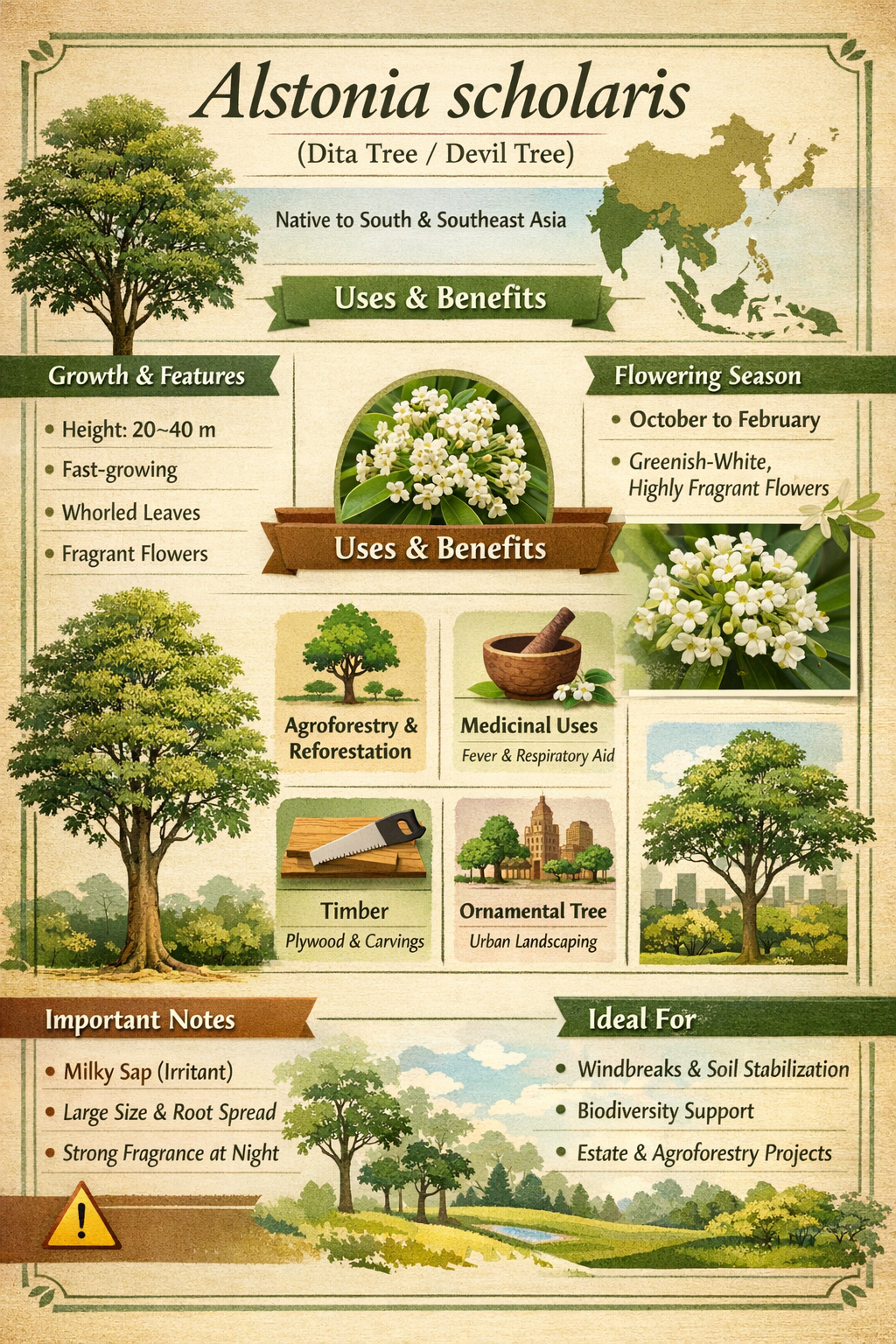
Common names: Dita, Devil Tree, Blackboard Tree
Family: Apocynaceae
Native range: South & Southeast Asia (including the Philippines)
Alstonia scholaris is a fast-growing evergreen tree widely planted in the Philippines for reforestation, landscaping, and medicinal use. It is known for its straight trunk, whorled leaves, and fragrant flowers.
Flowering (Blooming Time)
- Typically blooms after 5–8 years from planting
- May bloom earlier (around 4–5 years) if:
- grown from healthy seedlings
- planted in fertile, well-drained soil
- given full sun exposure
Flowering season (Philippines):
- Usually October to February
- Produces small, greenish-white, highly fragrant flowers
Growth Characteristics
- Height: 20–40 meters
- Growth rate: Fast
- Canopy: Dense, symmetrical
- Leaves: Arranged in whorls (distinctive layered look)
Uses & Value
1. Agroforestry & Reforestation
- Excellent for windbreaks and soil stabilization
- Tolerant to poor soils
2. Medicinal Uses
- Bark traditionally used for:
- fever
- respiratory conditions
- Contains alkaloids with pharmacological properties
3. Timber
- Light wood used for:
- plywood
- carvings
- blackboards (hence “scholaris”)
4. Ornamental
- Popular roadside and urban tree due to:
- uniform shape
- fragrant blooms
Considerations
- Latex (milky sap) can be irritating
- Strong fragrance may be overwhelming for some people at night
- Not ideal very close to houses due to size and root spread