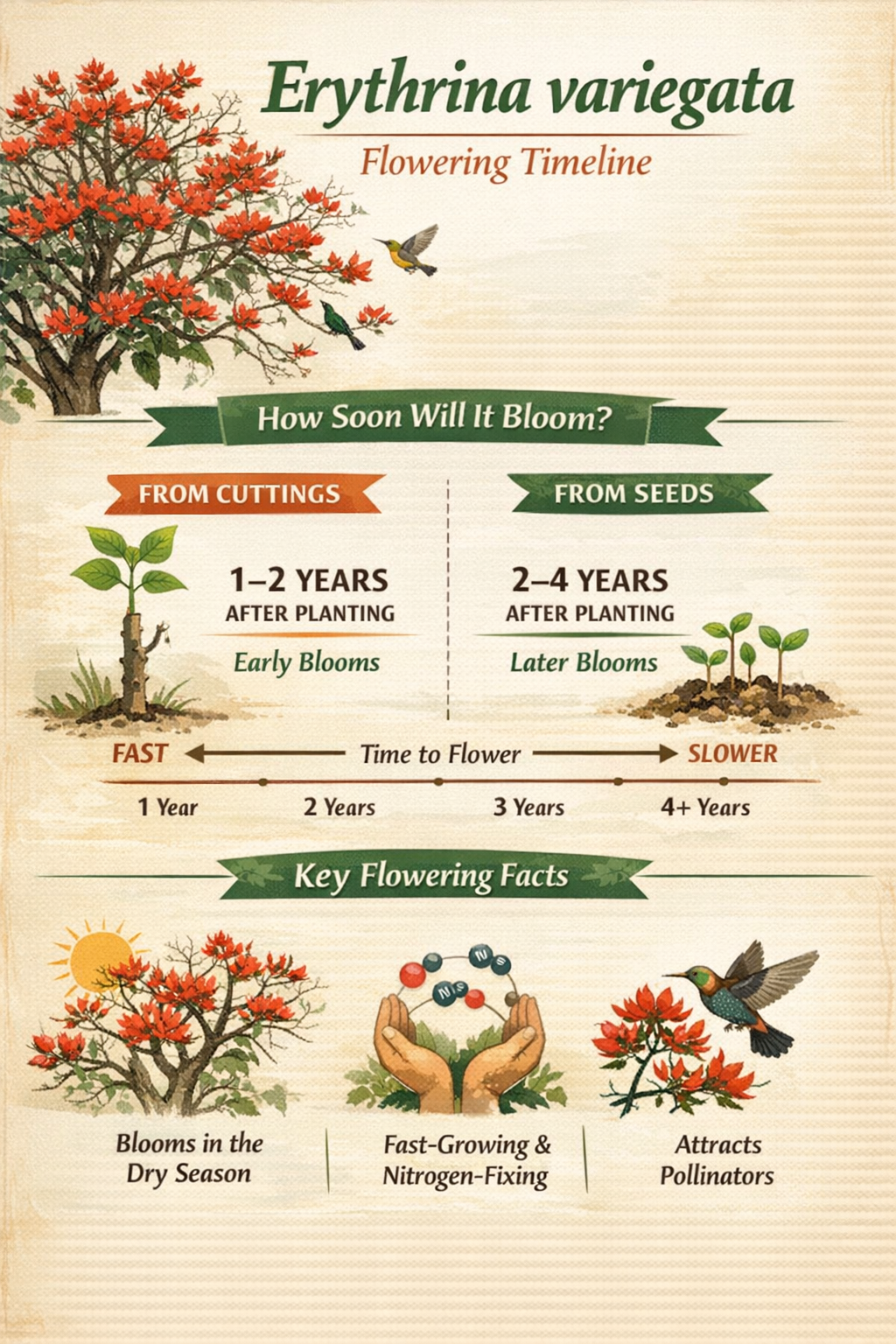
Common names: Indian Coral Tree, Tiger’s Claw, Dapdap (Philippines)
Erythrina variegata is a fast-growing, deciduous tropical tree widely used in agroforestry systems, coastal protection, and ornamental landscaping. It belongs to the legume family (Fabaceae), making it highly valuable for soil improvement through nitrogen fixation.
Key Characteristics
- Height: 10–20 meters
- Growth rate: Fast
- Leaves: Trifoliate (three leaflets), broad and soft
- Flowers: Bright red to orange, coral-shaped blooms
- Trunk: Often thorny when young
- Deciduous: Sheds leaves before flowering (dry season)
Flowering & Aesthetic Value
- Produces striking red flowers during the dry season
- Highly attractive to birds, especially nectar feeders
- Ideal as a visual focal tree in estates and farm landscapes
Agroforestry & Ecological Functions
- Nitrogen Fixation
- Improves soil fertility by converting atmospheric nitrogen into usable forms
- Enhances productivity of intercrops (e.g., cacao, coffee, agarwood)
- Shade Tree
- Commonly used in plantations for:
- Theobroma cacao
- Coffea arabica
- Vanilla planifolia
- Provides filtered shade and microclimate regulation
- Commonly used in plantations for:
- Living Fence / Windbreak
- Easily propagated via cuttings
- Forms natural barriers for farms and estates
- 4. Coastal & Erosion Control
- Tolerates saline and sandy soils
- Stabilizes coastal and degraded lands
Uses & Economic Value
- Fodder: Leaves used as livestock feed
- Green manure: Biomass improves soil organic matter
- Timber: Lightweight, used for carvings and small crafts
- Traditional medicine: Bark and leaves used in folk remedies
- Ornamental: Widely planted along roads and parks
Propagation & Cultivation
Propagation Methods
- Stem cuttings (preferred): Fast and reliable
- Seeds: Viable but slower
Growing Conditions
- Climate: Tropical to subtropical
- Sunlight: Full sun
- Soil: Well-drained; tolerates poor soils
- Water: Moderate; drought-tolerant once established
Considerations
- Brittle branches—prone to breakage in strong winds
- Deciduous nature may create seasonal leaf litter
- Needs spacing due to wide canopy
Strategic Value for Agroforestry (Your Context)
For your TerraForestry™ and agarwood systems, Erythrina variegata is highly strategic:
- Acts as a nurse tree for young Aquilaria malaccensis
- Enhances soil biology and nitrogen availability
- Provides temporary shade during early plantation stages
- Supports biodiversity and pollinator attraction
Position in Agroforestry Design
- Upper/Support Layer Tree
- Ideal spacing: 6m–10m depending on system density
- Best integrated in mixed-species plantations