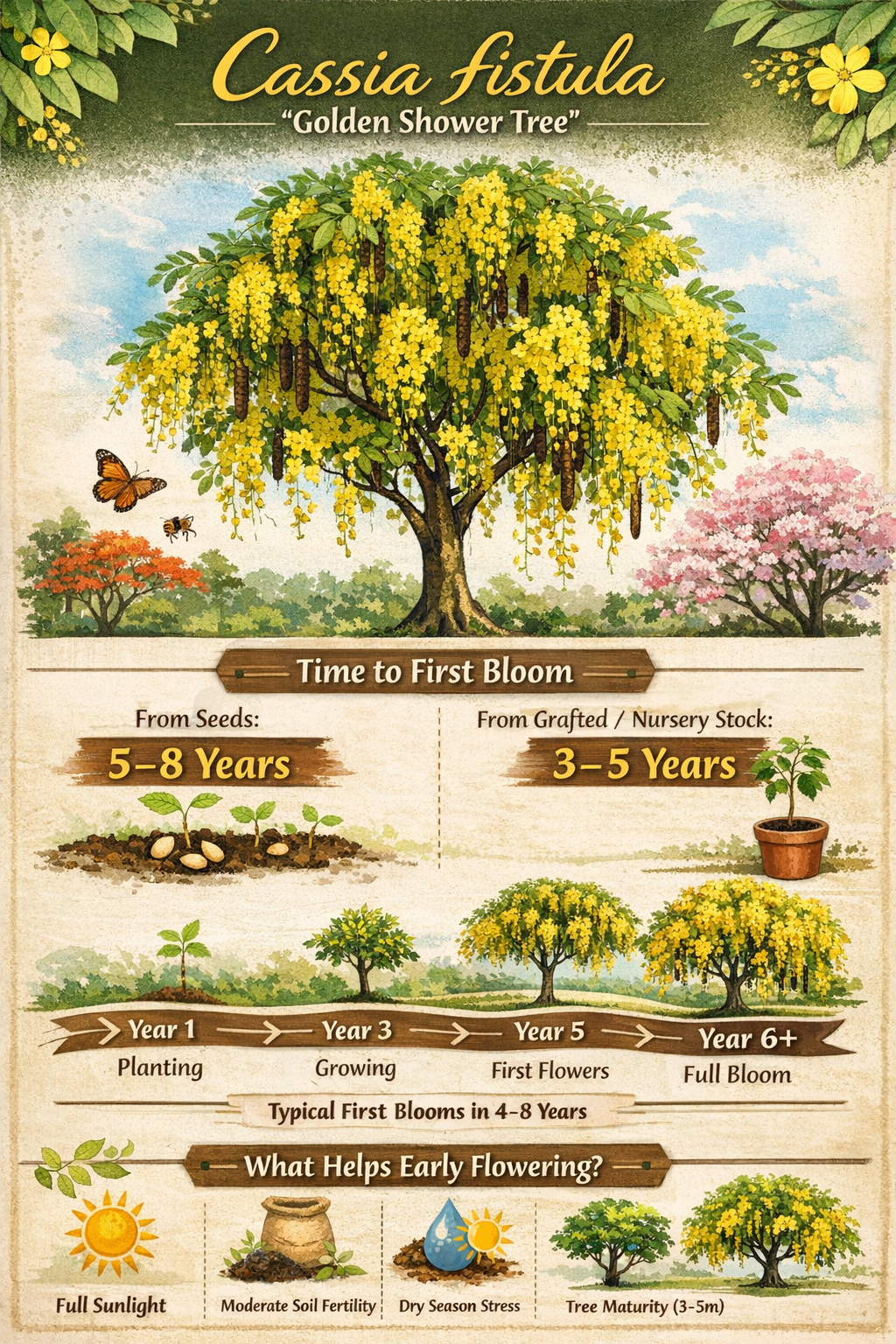
(Common names: Golden Shower Tree, Indian Laburnum, Purging Cassia)
Cassia fistula is a striking ornamental flowering tree famous for its long cascades of bright yellow blooms, often seen during the dry season. It is widely planted across tropical regions, including the Philippines, for landscaping and cultural significance.
Botanical Profile
- Family: Fabaceae (Legume family)
- Height: 10–20 meters
- Crown: Open, spreading canopy
- Leaves: Deciduous, pinnate leaves that shed before flowering
- Flowers: Golden-yellow, hanging clusters (racemes up to 50 cm long)
- Fruit: Long cylindrical pods (30–60 cm), dark brown/black when mature
Flowering Characteristics
- Blooms profusely in summer / dry season
- Often flowers when leafless → creates a dramatic “golden rain” effect
- Highly attractive to bees and pollinators
Ecological & Agroforestry Value
- Nitrogen-fixing tree (improves soil fertility)
- Supports pollinator biodiversity
- Provides light shade—ideal for mixed agroforestry systems
- Can be integrated as an ornamental boundary or avenue tree
Uses & Benefits
- Ornamental & Landscaping
- One of the most beautiful flowering trees for avenues, parks, and estates
- Ideal for luxury farm developments and eco-tourism sites
- Creates strong seasonal visual impact (golden bloom corridors)
- Medicinal (Traditional Use)
- Pods and pulp used as a mild laxative
- Bark and leaves used in traditional medicine (antimicrobial, anti-inflammatory)
- Wood
- Moderately hard wood used for light construction, tools, and fuelwood
Propagation & Cultivation
Propagation Methods:
- Seeds (most common)
- Scarification improves germination
Growing Conditions:
- Full sun
- Tropical climate with a distinct dry season
- Well-drained soils (tolerates poor soils once established)
- Drought-tolerant after establishment
Considerations
- Slow to moderate growth rate
- Pods can be messy when falling
- Requires space due to spreading canopy